
A thesis statement is the foundation of any successful academic paper. It clearly expresses the main argument or claim and guides both the writer and the reader through the essay. Without a strong thesis statement, an essay can feel unfocused and confusing. For students and researchers, knowing how to write a strong thesis statement is essential for achieving clarity, credibility, and higher academic scores.
In this article, we will break down the process step by step, discuss different types of thesis statements, share examples, and answer common questions. By the end, you will not only understand what makes a thesis statement strong but also be able to craft one that elevates your writing.
What Is a Thesis Statement? (Definition)
A thesis statement is a single sentence, usually at the end of an introduction, that summarizes the central argument or point of a paper. It serves as a roadmap for readers and ensures that every part of the essay connects back to the main argument.
✅ Featured Snippet-Ready Definition:
A thesis statement is a concise sentence that presents the central argument or claim of an essay, guiding the reader by outlining the paper’s purpose and direction.
Why Is a Strong Thesis Statement Important?
A strong thesis statement is critical because it:
- Clarifies the purpose of your paper.
- Helps maintain focus and logical flow.
- Engages readers with a clear argument.
- Demonstrates academic credibility.
Think of it as the “compass” of your essay. Without it, you risk wandering off-topic.
Characteristics of a Strong Thesis Statement
When learning how to write a strong thesis statement, keep these qualities in mind:
- Clarity: It should be specific and unambiguous.
- Conciseness: A thesis should be one to two sentences long.
- Arguability: It must make a claim that can be supported or challenged.
- Relevance: It should directly answer the essay question or address the research topic.
Types of Thesis Statements
Depending on the assignment, your thesis may take different forms:

| Type | Purpose | Example |
|---|---|---|
| Argumentative | Takes a stance and persuades readers. | “Governments should invest in public transportation to reduce pollution and improve urban living.” |
| Analytical | Breaks down an issue into parts and evaluates it. | “The rise of renewable energy highlights economic, environmental, and social benefits for sustainable development.” |
| Expository | Explains a topic without taking sides. | “The Great Depression had widespread effects on American society, from employment to culture.” |
Step-by-Step Guide: How to Write a Strong Thesis Statement
1. Understand Your Assignment
Carefully read the essay prompt or research question. Ask: What is being asked?
2. Narrow Down Your Topic
A broad topic is hard to defend. Focus on one main idea.
3. Take a Position
Avoid vague statements. Make a clear argument that reflects your viewpoint.
4. Use Specific Language
Replace general terms with precise wording.
5. Place It Strategically
Your thesis should appear at the end of your introduction.
Formula for Writing a Strong Thesis
A simple formula to craft your thesis is:
Topic + Your Claim + Supporting Points
Example:
“Social media has transformed modern communication by improving connectivity, reshaping personal relationships, and influencing public opinion.”
Common Mistakes to Avoid
- ❌ Being too vague: “Technology is important.”
- ❌ Writing a fact instead of a claim: “Water boils at 100°C.”
- ❌ Making it too long or complex.
- ❌ Forgetting to take a position.
Examples of Strong vs. Weak Thesis Statements
| Weak Thesis | Strong Thesis |
|---|---|
| “Pollution is bad for the environment.” | “Industrial pollution contributes to climate change, damages ecosystems, and poses health risks, making stricter environmental laws essential.” |
| “Shakespeare was a good writer.” | “Shakespeare’s use of complex characters and universal themes has ensured his lasting influence on modern literature.” |
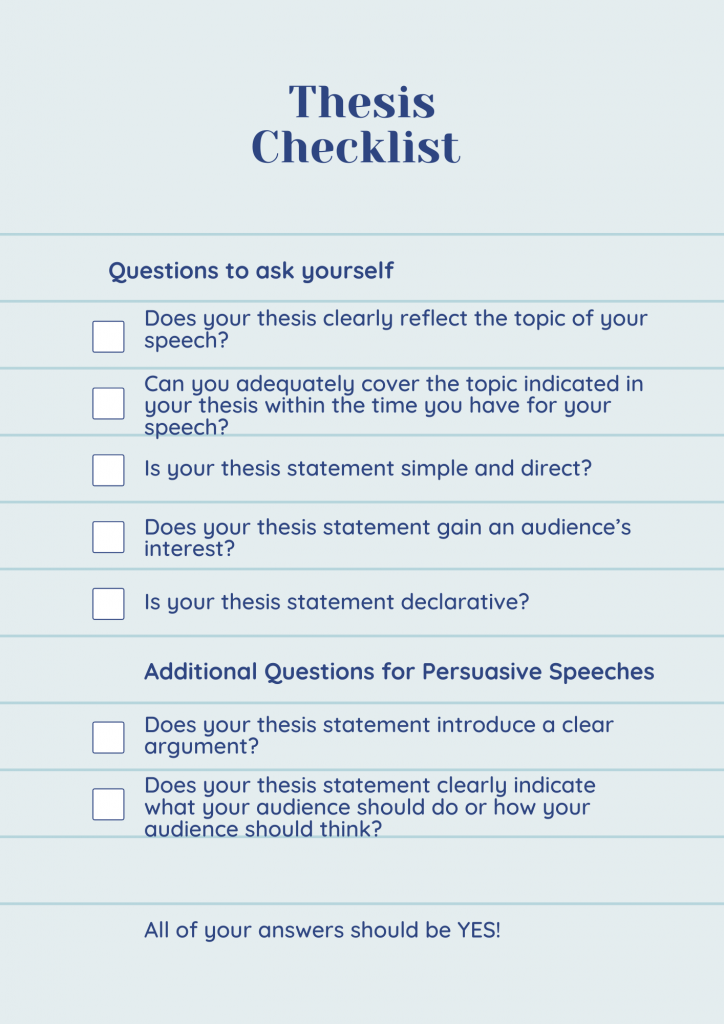
Tips for Refining Your Thesis Statement
- Revise after drafting your essay.
- Ask yourself: Does this answer the research question?
- Check if every paragraph connects back to your thesis.
- Get feedback from peers or professors.
FAQs About Writing a Strong Thesis Statement
What are the 3 parts of a thesis statement?
A strong thesis statement includes the topic, your position or claim, and the supporting points that back up your argument.
How long should a thesis statement be?
Ideally, one to two concise sentences. Any longer may confuse readers.
Where does the thesis statement go?
Typically at the end of the introduction, serving as a transition into the body paragraphs.
Can a thesis statement be a question?
No, a thesis must make a declarative statement, not ask a question.
Conclusion
Learning how to write a strong thesis statement is one of the most valuable skills in academic writing. A clear, concise, and arguable thesis guides your essay, keeps you focused, and engages your readers. Always remember to refine it as your ideas evolve during the writing process.
If you want to strengthen your academic writing even further, explore our detailed guides on [Link to related article about essay writing strategies] or check out resources from [External link to Purdue OWL Writing Lab].
Call to Action: Start drafting your thesis statement today, and if you need any help Contact Us.